Apple September 9 "It's Glowtime" Event Recap: iPhone 16 Series, Apple Intelligence, Apple Watch Series 10, and AirPods 4
Executive Summary
The definitive technical breakdown of Apple's September 9 keynote: iPhone 16 and 16 Pro, next-generation 3nm A18 silicon, Apple Intelligence architecture, Apple Watch Series 10, and AirPods 4 ANC.
📊 Market Strategic Impact
Apple transitions its entire consumer hardware portfolio to native on-device generative AI acceleration, setting the benchmark for privacy-preserving mobile inference with A18 and Private Cloud Compute.
Apple September 9 "It's Glowtime" Event Recap: iPhone 16 Series, Apple Intelligence, Apple Watch Series 10, and AirPods 4
Direct Answer / Executive Summary: At its marquee September 9 keynote streamed worldwide from the Steve Jobs Theater at Apple Park, Cupertino, Apple officially unveiled the iPhone 16, iPhone 16 Plus, iPhone 16 Pro, and iPhone 16 Pro Max. Anchored by second-generation TSMC 3-nanometer silicon (A18 and A18 Pro), the entire lineup has been re-architected from the ground up to support Apple Intelligence alongside a capacitive Camera Control hardware button. Companion announcements included the ultra-thin Apple Watch Series 10, a Satin Black Apple Watch Ultra 2, and AirPods 4 with optional open-ear Active Noise Cancellation.
| Device | Silicon / Process | Display Size | Starting Price (USD) | | :--- | :--- | :--- | :--- | | iPhone 16 | A18 (3nm N3E) | 6.1" OLED 60Hz | $799 (128GB) | | iPhone 16 Plus | A18 (3nm N3E) | 6.7" OLED 60Hz | $899 (128GB) | | iPhone 16 Pro | A18 Pro (3nm N3E) | 6.3" OLED 120Hz | $999 (128GB) | | iPhone 16 Pro Max | A18 Pro (3nm N3E) | 6.9" OLED 120Hz | $1,199 (256GB) | | Apple Watch Series 10 | S10 SiP | 42mm / 46mm Wide-OLED | $399 (Aluminum) | | AirPods 4 | H2 Headphone Chip | Open-Ear Acoustic Design | $129 (Base) / $179 (ANC) |
Key Takeaways from the September 9 Keynote
The Paradigm Shift: Hardware Engineered Around Apple Intelligence
For years, smartphone hardware iterations followed predictable paths: megapixel increments, display bezel reductions, and annual single-threaded CPU gains. The September 9 announcements marked a foundational architectural pivot: hardware co-designed exclusively to host local generative foundation models.
At the core of this strategy is Apple's unified memory architecture. Generative models—such as on-device diffusion networks and localized large language models (LLMs)—require substantial bandwidth to avoid memory-bound execution stalls. By outfitting both the iPhone 16 baseline models and the iPhone 16 Pro series with 8GB of LPDDR5X-class unified memory and 17% higher bus bandwidth, Apple ensured that generative context caching and localized token generation happen without system stutter.
When tasks exceed local parameter boundaries, the architecture seamlessly shifts inference workloads to Private Cloud Compute (PCC). Running on custom Apple Silicon nodes in hardened server enclosures, PCC executes complex multi-step reasoning without persisting user data or logging telemetry. Independent security auditors can cryptographically inspect every binary release running on Apple's servers, representing a milestone in verifiable cloud privacy. For a deep architectural analysis, explore our dedicated breakdown of Apple Intelligence on iPhone 16.
iPhone 16 & iPhone 16 Plus: Elevating the Baseline Standard
The baseline iPhone lineup received its most aggressive feature elevation in more than half a decade.
| Attribute | iPhone 16 | iPhone 16 Plus | | :--- | :--- | :--- | | Display Dimensions | 6.1-inch Super Retina XDR | 6.7-inch Super Retina XDR | | Resolution & Density | 2556 x 1179 px (460 ppi) | 2796 x 1290 px (460 ppi) | | Brightness Dynamic Range | 1 nit min / 2000 nits peak | 1 nit min / 2000 nits peak | | System Processor | Apple A18 (6-Core CPU, 5-Core GPU) | Apple A18 (6-Core CPU, 5-Core GPU) | | Neural Compute | 16-Core NPU (35 TOPS) | 16-Core NPU (35 TOPS) | | Primary Camera | 48MP Fusion (26mm, f/1.6) | 48MP Fusion (26mm, f/1.6) | | Telephoto Equivalent | 12MP 2x Crop (52mm, f/1.6) | 12MP 2x Crop (52mm, f/1.6) | | Ultra-Wide Optics | 12MP Autofocus Macro (f/2.2) | 12MP Autofocus Macro (f/2.2) | | Physical Controls | Action Button + Camera Control | Action Button + Camera Control | | Video Playback Battery | Up to 22 Hours | Up to 27 Hours | | Weight | 170 grams | 199 grams | | Color Enclosure | Ultramarine, Teal, Pink, White, Black | Ultramarine, Teal, Pink, White, Black |
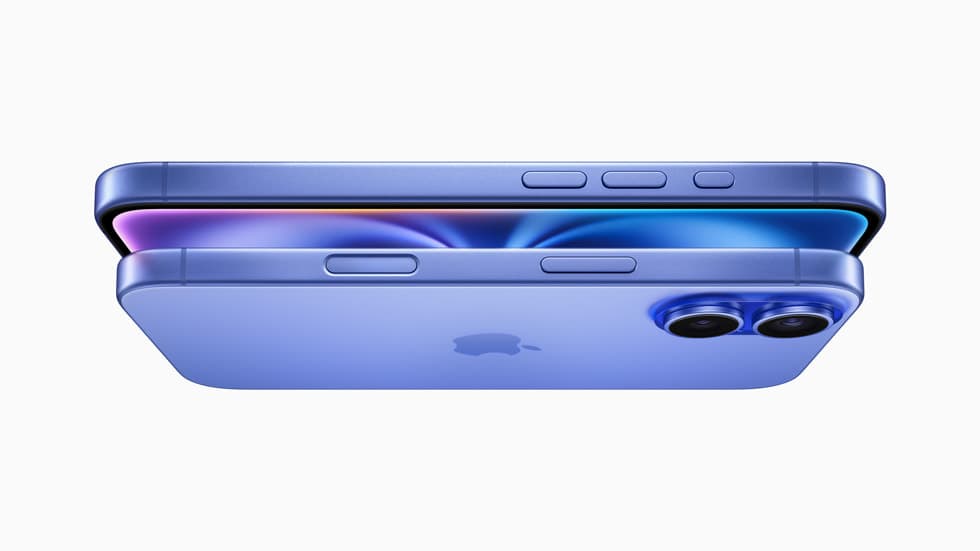
The rear optics transition from the diagonal arrangement back to a vertical pill-shaped camera island. This modification is functional: it enables the dual lenses to capture synchronized stereoscopic video and spatial audio formatted specifically for playback on the Apple Vision Pro.
Furthermore, the addition of the Action Button (previously exclusive to the iPhone 15 Pro) combined with the brand-new Camera Control gives entry-tier buyers complete access to tactile camera adjustments, instant voice memo captures, and custom workflow triggers.
iPhone 16 Pro & iPhone 16 Pro Max: Uncompromised Creative Engine
The Pro tier pushes the boundary of handheld production workflows, powered by the A18 Pro system-on-chip:
1. 4K 120 fps Dolby Vision HDR Capture: A world first in mobile video, allowing filmmakers and creators to capture slow motion in full 4K Dolby Vision, with frame-by-frame color grading in the native Photos app, Final Cut Pro, or DaVinci Resolve. 2. Audio Mix Studio Architecture: Utilizing an onboard 4-microphone studio array, iPhone 16 Pro isolates background noise and lets users choose between In-Frame, Studio, and Cinematic vocal mastering after recording. 3. Display Real Estate: Through ultra-narrow border integration, screen sizes expand to 6.3 inches and 6.9 inches without significantly altering hand ergonomics. 4. Thermal Optimization: A bonded 100% recycled aluminum internal chassis combined with graphite cooling layers delivers up to 20% better sustained performance, mitigating the thermal throttling observed in previous titanium iterations.
For consumers weighing whether to upgrade from earlier hardware generations, review our granular iPhone 16 vs iPhone 15 vs iPhone 16 Pro Buyer's Guide.
Companion Hardware: Apple Watch Series 10 & AirPods 4
Apple also completely overhauled its peripheral and wearable lines during the keynote:
Read our complete architectural tear-down of the September 9 Wearables Ecosystem.
Complete Pricing, Pre-Order, and Global Availability Schedule
| Product | Base Price (USD) | Availability Milestones | | :--- | :--- | :--- | | iPhone 16 (128GB) | $799 | Pre-orders: Sept 13 \| In-Store: Sept 20 | | iPhone 16 Plus (128GB) | $899 | Pre-orders: Sept 13 \| In-Store: Sept 20 | | iPhone 16 Pro (128GB) | $999 | Pre-orders: Sept 13 \| In-Store: Sept 20 | | iPhone 16 Pro Max (256GB) | $1,199 | Pre-orders: Sept 13 \| In-Store: Sept 20 | | Apple Watch Series 10 | $399 (Aluminum) | Orders Live Sept 9 \| In-Store: Sept 20 | | Apple Watch Ultra 2 (Black) | $799 (Titanium) | Orders Live Sept 9 \| In-Store: Sept 20 | | AirPods 4 (Standard) | $129 | Orders Live Sept 9 \| In-Store: Sept 20 | | AirPods 4 (ANC) | $179 | Orders Live Sept 9 \| In-Store: Sept 20 |
Frequently Asked Questions (FAQ)
When did the Apple September 9 event take place and what was announced?
Apple hosted its "It's Glowtime" special event on Monday, September 9, at 10:00 AM PT from the Steve Jobs Theater at Apple Park. Apple officially announced the iPhone 16, iPhone 16 Plus, iPhone 16 Pro, iPhone 16 Pro Max, Apple Watch Series 10, Apple Watch Ultra 2 in Satin Black, AirPods 4 (both standard and ANC variants), and USB-C AirPods Max.Which iPhone 16 models support Apple Intelligence?
All four iPhone 16 models—the iPhone 16, iPhone 16 Plus, iPhone 16 Pro, and iPhone 16 Pro Max—fully support Apple Intelligence. Unlike the iPhone 15 generation where only the 15 Pro models supported it, the baseline iPhone 16 features the necessary A18 silicon and 8GB RAM.What does the new Camera Control button do?
Camera Control is a multi-function capacitive and tactile control located on the lower right chassis. A click opens the Camera app, another click captures an image, holding records video, and light-pressing brings up a slider to swipe through zoom levels, exposure values, and custom photographic styles. It also serves as the launchpad for Visual Intelligence.What is the difference between A18 and A18 Pro?
Both chips are built on TSMC's 2nd-generation 3nm process and feature a 16-core 35 TOPS Neural Engine. However, the A18 Pro features a 6-core GPU (versus 5-core on A18), higher CPU clock speeds, an Advanced Media Engine supporting ProRes and 4K 120fps Dolby Vision, and USB 3 speeds up to 10Gb/s (versus USB 2 on A18).The Overwatch Verdict
Apple’s September 9 event was not merely an incremental hardware refresh; it established the baseline silicon and interaction design architecture for the next decade of ambient personal computing. By democratizing the Action Button, Camera Control, and 8GB of memory across the entire lineup, Apple ensured that every customer entering the ecosystem is fully equipped to leverage localized artificial intelligence without sacrificing privacy or battery endurance.
*
Sources & References:
Community Sentiment
0 votes · 0 up · 0 down