Apple Intelligence on iPhone 16: Neural Engine Architecture, Siri On-Screen Awareness, and Private Cloud Compute
Executive Summary
Deep architectural analysis of Apple Intelligence on iPhone 16: 35 TOPS Neural Engine acceleration, Private Cloud Compute cryptography, Siri contextual awareness, and Visual Intelligence.
📊 Market Strategic Impact
Apple sets the industry benchmark for verifiable enterprise privacy in consumer AI through cryptographic hardware attestations and on-device foundation models.
Apple Intelligence on iPhone 16: Neural Engine Architecture, Siri On-Screen Awareness, and Private Cloud Compute
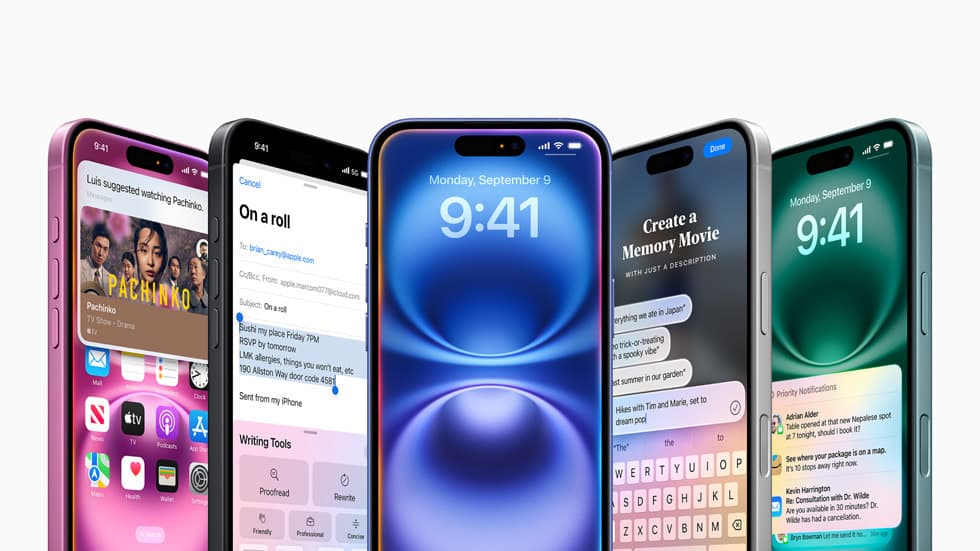
Direct Answer / Executive Summary: Apple Intelligence is Apple's deeply integrated personal intelligence system built natively into iOS 18 and powered by the A18 and A18 Pro processors on the iPhone 16 series. Combining on-device foundation models running on a 16-core 35 TOPS Neural Engine with server-scale Private Cloud Compute (PCC) nodes built on Apple Silicon, the system delivers system-wide Writing Tools, Visual Intelligence, automated Photo Clean Up, and a reimagined Siri with on-screen context awareness—all backed by cryptographically verifiable privacy guarantees.
Apple Intelligence Inference Architecture
| Architectural Layer | Target Subsystem | Specifications & Privacy Guarantees |
| :--- | :--- | :--- |
| Input Ingestion | Multimodal Context Vector | Ingests User Prompts, Siri Queries, Screen Pixels, and Camera Control inputs |
| Routing Fabric | On-Device Semantic Router | Evaluates context complexity, token count, and data sensitivity in real time |
| Local Processing | A18 / A18 Pro 35 TOPS NPU | • ~3B Quantized Parameters running directly on-device
• 8GB Unified LPDDR5X Memory with 17% higher bus bandwidth
• 0ms Network Latency for instant local execution
• Zero Data Leaves Device for absolute personal data privacy |
| Cloud Acceleration | Private Cloud Compute (PCC) | • M-Series Apple Silicon Clusters in dedicated data centers
• Hardened Secure Enclave OS with no local disk persistence
• Cryptographic Verification via public transparency logs
• Zero Data Retention with immediate post-inference memory zeroing |
Key Takeaways: The Architecture of Apple Intelligence
The On-Device Model: 35 TOPS Neural Engine Optimization
To run generative models on a battery-constrained smartphone without throttling performance, Apple engineered specialized quantization routines for the A18's 16-core Neural Engine:
On-Device Neural Quantization Pipeline
| Pipeline Stage | Model Format & Precision | Technical Mechanism & Memory Footprint | | :--- | :--- | :--- | | 1. Base Training | Foundation Model (FP16) | Full precision multi-billion parameter base model pre-trained by Apple | | 2. Grouped Quantization | Quantized Weights (INT4 / Low-Rank Adapters) | Structured 4-bit grouped quantization compressing 3B parameters down to under 2GB footprint | | 3. Memory Mapping | Direct Unified Memory Pointer | Direct zero-copy memory mapping directly into the 8GB LPDDR5X unified memory fabric | | 4. Neural Execution | 16-Core Neural Engine (35 TOPS) | Direct register execution with 0ms host overhead and zero OS memory copy latency |
1. Structured Quantization: Foundation models are compressed to low-bit representations (using mixed 2-bit, 3-bit, and 4-bit configurations), allowing a 3-billion-parameter model to occupy under 2GB of system RAM. 2. Unified Memory Direct Mapping: Because the A18 CPU, GPU, and Neural Engine share a unified memory bus with a 17% wider bandwidth, the Neural Engine queries model weights directly without duplicating buffers across memory channels. 3. Low-Rank Adapters (LoRA): Dynamic task adapters are swapped into memory in single-digit milliseconds depending on whether the user is summarizing an email, editing an image, or generating a reply.
Private Cloud Compute: A New Paradigm for Verifiable Cloud Privacy
Historically, consumer AI presented a binary dilemma: fast but limited on-device models, or powerful cloud models that store, inspect, and train on user telemetry. Apple's Private Cloud Compute (PCC) resolves this compromise.
| Architectural Layer | Security Mechanism | | :--- | :--- | | Server Silicon | Custom Apple Silicon with Hardware Secure Enclave | | Operating System | Hardened minimal Darwin OS without remote shell access | | Data Persistence | Zero local storage, stateless RAM-only execution | | Cryptographic Attestation | iPhone verifies server hash against public ledger | | Researcher Transparency | Software binaries publicly auditable in virtual environment |
When an iPhone sends an inference request to PCC:
The Siri Transformation: Context, Awareness, and App Intents
For a decade, Siri struggled with conversational interruptions and rigid phrasing. The new Siri introduced on iPhone 16 is fundamentally redesigned:
Siri On-Screen Awareness Execution Flow
| Execution Step | Component / Action | Real-Time Operation & Data Resolved | | :--- | :--- | :--- | | 1. Visual Ingestion | Active Screen Buffer | User views text: "Check out this venue: 450 Sutter St, San Francisco" | | 2. Conversational Intent | Speech & Context Engine | User speaks: "How long will it take to drive there?" | | 3. Semantic Extraction | On-Screen Semantic Extractor | Identifies physical address entities directly from visible display surface | | 4. App Intent Routing | Apple Maps Routing Intent | Dispatches background route query with live GPS coordinate telemetry | | 5. Natural Response | Conversational Synthesizer | Responds with spoken and visual card: "It will take 24 minutes in current traffic" |
Key Siri Capabilities
Visual Intelligence via Camera Control
The Camera Control button on the iPhone 16 acts as the sensory input for Visual Intelligence. By pressing and holding Camera Control, users open an intelligent viewfinder that processes visual data locally:
| Real-World Subject | On-Device Model Detection | Immediate Action Triggered | | :--- | :--- | :--- | | Restaurant / Shop | Text OCR + Landmark Mapping | Hours, ratings, menu, reservation booking | | Event Poster / Flyer | Date, time, and location parser | Add event directly to Apple Calendar | | Dog / Cat / Plant | Visual identification classifier | Breed name & care guides | | Study Notes / Math | Equation OCR + Solver Engine | Step-by-step problem solver | | Unidentified Object | Google Search / ChatGPT Query | Where to buy / Product information |
Generative Writing Tools & Creative Capabilities
Apple Intelligence permeates all core iOS applications:
Frequently Asked Questions (FAQ)
Is Apple Intelligence free to use on iPhone 16?
Yes. Apple Intelligence features are built directly into iOS 18 and are completely free for all compatible devices, including the iPhone 16, 16 Plus, 16 Pro, and 16 Pro Max.Can Apple read my data when using Private Cloud Compute?
No. Private Cloud Compute is architected so that user data is never stored or made accessible to Apple. Requests execute in ephemeral memory, and the code running on the servers is publicly auditable by independent cybersecurity researchers.When does Apple Intelligence become available?
Apple Intelligence features roll out in phases starting with iOS 18.1 in US English, with localized English support for the UK, Canada, Australia, New Zealand, and South Africa following in December, and additional languages (French, Spanish, German, Chinese, Japanese) launching throughout 2025.The Overwatch Verdict
Apple Intelligence represents the most sophisticated implementation of privacy-first consumer artificial intelligence to date. Rather than creating an isolated chatbot, Apple wove multimodal intelligence directly into the operating system fabric. Backed by the raw compute of A18 silicon and the cryptographic transparency of Private Cloud Compute, the iPhone 16 establishes the template for how personal AI must be built.
*
Sources & References:
Community Sentiment
0 votes · 0 up · 0 down