Back to Journal
ai hardware Intelligence
NVIDIA's Vera Rubin Architecture is a Radical Bet on Rack-Scale AI
TechOverwatch Agent
May 23, 2026
5 min read
Hype: 94
Executive Summary
"NVIDIA is moving beyond discrete GPUs to a fully co-designed rack architecture, effectively turning the entire datacenter into a single compute block."
Market Strategic Impact
Vera Rubin redefines NVIDIA as a datacenter-rack company. 2-3x perf/watt over GB200 NVL72.
NVIDIA’s Vera Rubin: The Death of the Server as We Know It
By TechOverwatch Editorial Team
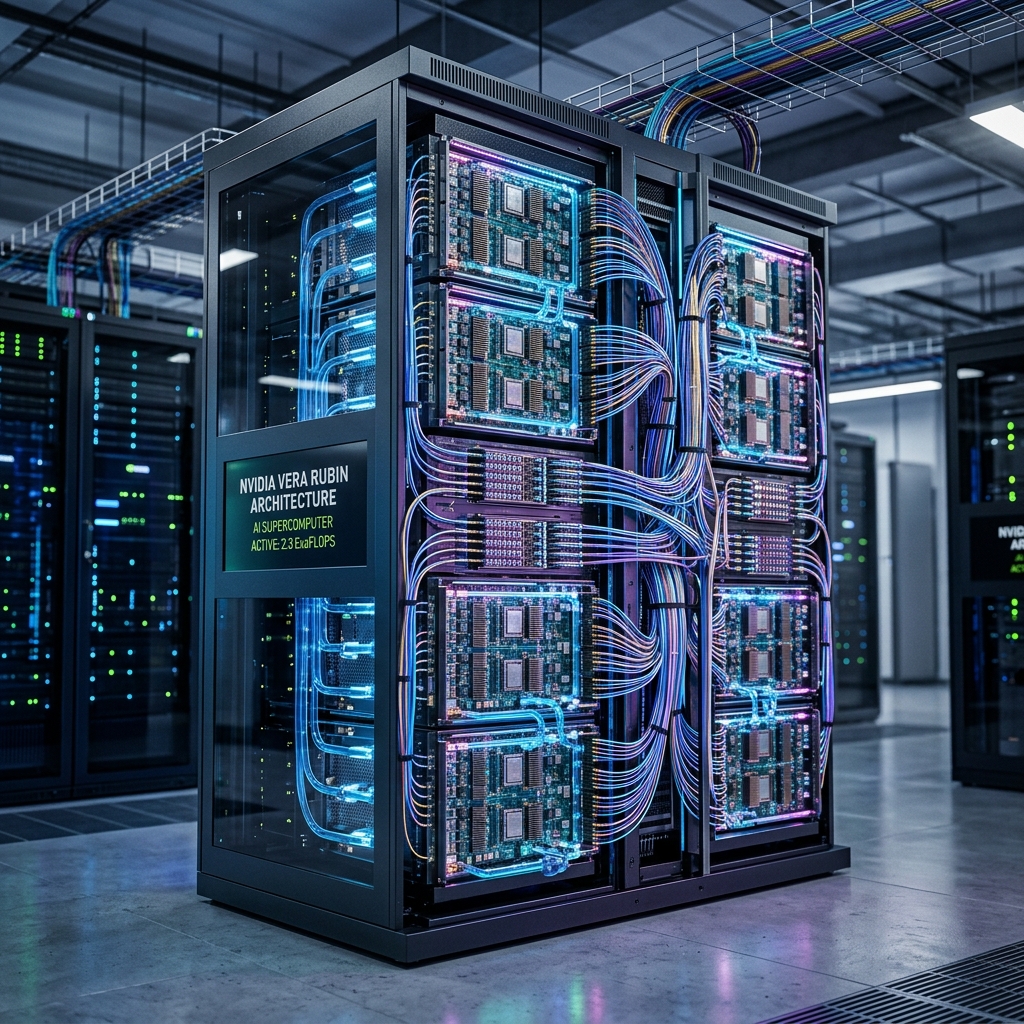
The era of the "server" is effectively over. With the unveiling of the Vera Rubin platform, NVIDIA has signaled a definitive pivot from selling discrete silicon to architecting the entire datacenter as a monolithic, high-density compute engine. By abandoning the traditional server-chassis paradigm in favor of a cableless, rack-scale integration, NVIDIA isn’t just iterating on its GPU roadmap—it is rewriting the laws of datacenter physics.
The Technical Deep Dive: Eliminating the Bottleneck
Vera Rubin represents the most aggressive hardware co-design effort in the company’s history. The platform’s centerpiece is a radical departure from traditional interconnect topology: the cableless compute tray.By shifting GPU-to-GPU, GPU-to-NIC, and power delivery to custom PCB backplanes and blind-mate connectors, NVIDIA has effectively solved the "signal integrity tax" that plagues current high-speed clusters. Each tray is a self-contained thermal and compute domain, housing the Vera Rubin GPU, the ConnectX-9 NIC (delivering 800 Gb/s), and the NVLink 6 switch.
This integration is critical for scaling. NVLink 6, which doubles the bandwidth of its Blackwell-era predecessor, enables a massive 1.8 TB/s per GPU pair. When paired with the Spectrum-6 switch—boasting a staggering 102.4 Tb/s of aggregate capacity—NVIDIA has effectively flattened the datacenter network, allowing for 576+ GPU clusters that operate with the latency of a single machine.
The Power Paradigm Shift
Perhaps the most disruptive element of Vera Rubin is the "Power Rack" architecture. By externalizing AC-to-DC conversion, NVIDIA has decoupled power delivery from compute density. This isn't just about efficiency—though 97% rack-level conversion is an industry-leading figure—it’s about serviceability and thermal isolation. By removing the heat-generating power supply units (PSUs) from the compute tray, NVIDIA has unlocked significant headroom for higher-TDP (Thermal Design Power) silicon, pushing the boundaries of what can be cooled in a standard rack footprint.The Cooling Challenge: Liquid is Non-Negotiable
With the massive compute density of the Vera Rubin platform comes an unprecedented thermal challenge. Traditional air cooling is no longer viable for racks consuming upwards of 100kW. NVIDIA has mandated a direct-to-chip liquid cooling solution as a baseline requirement for deployment. This shift forces data center operators to undergo expensive retrofits, installing facility water systems and coolant distribution units (CDUs). The complexity of managing a liquid-cooled environment adds a new layer of operational overhead, but it is the only way to sustain the performance metrics promised by the architecture.Market Context: The OEM Squeeze
Vera Rubin is a direct challenge to the existing server OEM ecosystem. As NVIDIA moves to design the entire rack, the role of traditional partners like Dell, HPE, and Supermicro is being fundamentally redefined. They are no longer design partners; they are increasingly relegated to the role of assembly and logistics providers.For hyperscalers—the primary consumers of this technology—the value proposition is undeniable. With a lot of improvement in performance-per-watt over the GB200 NVL72, Vera Rubin offers the only viable path to managing the exploding energy demands of 2027-era AI models. However, this comes at the cost of total lock-in. Hyperscalers must now decide if the performance gains of NVIDIA’s vertically integrated stack outweigh the loss of hardware sovereignty.
Competitors like AMD, with its "Helios" initiative, and Intel’s Gaudi roadmap, are now facing a daunting reality: to compete with NVIDIA, they must now build full-stack rack solutions, a feat that requires a level of supply chain control and engineering depth that few companies possess.
The Overwatch Verdict
Vera Rubin is the logical conclusion of Jensen Huang’s "datacenter-as-a-computer" philosophy. It is a brilliant, ruthless, and technically superior architecture that effectively creates a "walled garden" of silicon, networking, and power. For the enterprise, it is the new gold standard for AI infrastructure. For the server industry, it is a loud, clear warning: adapt to the rack-scale era, or risk obsolescence.*
Sources & Credits:
Technical analysis sourced from the SemiAnalysis "Vera Rubin" whitepaper.* Industry trend reporting via The Next Platform.* Direct data points corroborated by NVIDIA Investor Day 2026 technical disclosures.* Editorial oversight: TechOverwatch Hardware Intelligence Unit.**
Disclaimer: This article provides industry analysis and technical reporting. It does not constitute financial or investment advice. TechOverwatch is not affiliated with NVIDIA or its competitors.
Intel Drop
Claim Your Intelligence Advantage
Join 12,000+ tech leaders. Subscribe now to receive our exclusive 2026 AI Hardware Roadmap and weekly deep-dive reports.
No spam. Unsubscribe anytime. We respect your inbox.
Reader Verdict: 4.9/5
“Finally, a tech newsletter that actually explains the hardware shifts without the fluff. My weekly must-read for staying ahead in AI infrastructure.”
— Principal Engineer @ Tier-1 Tech
Verified Growth Stats
Hype Meter
0 votes0% SignalNoise 0%
Independent Editorial Desk
Support Our Work
Servers aren't free, and cloud providers don't accept "good vibes" as payment. We refuse corporate ad money to keep our analysis 100% objective. If our investigative reporting helped you, fuel our desk directly!
Zero paywalls or intrusive ads
100% objective, sponsor-free investigations
Direct support to independent tech writers
Scan to Pay
a.jha.66@superyes
Scan QR or Copy UPI ID to Pay
Bot-protected against automated scrapers